mdblist.com logo The Best Hiroshi Ogasawara Movies. Go to The Best Shows


Ratings
Between
and
Between
and
Between
and
With at least
votes
Between
and
With at least
votes
Between
and
With at least
votes
Between
and
With at least
votes
Between
and
With at least
votes
Between
and
With at least
votes
Between
and
With at least
votes
Between
and
With at least
votes
Additional filters
m
Lists, Streaming Services, Cast and more
Create List (36 items)

Login to create a dynamic list


poster
?
10
/2/

Nonki saiban (1955)
A spectacular comedy with a star-studded cast that depicts unusual trials and unexpected verdicts regarding the five deadly sins: the crime of beauty, the crime of a terrifying wife, the crime of taking the wrong course, the crime of seducing, and the crime of killing with laughter.
poster
?
3.6
/12/
10
/1/

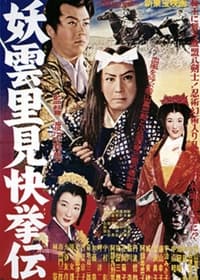
Mysterious Clouds: Legend of Satomi's Heroic Deed (1957)
In the first year of Chōroku, Satomi Yoshimi, lord of Takita Castle in Awa, faces defeat by neighboring lord Anzai Kagesuren. As the castle nears collapse, Anzai demands a seed from Yoshimi’s lineage, specifically from his wife, Fushihime. Outraged but facing annihilation, Yoshimi gives Fushihime a string of eight ancestral beads and urges her to escape to loyal retainer Inuda Kobungo. Instead, she goes alone to Anzai, followed by her dog, Hachibo. In a twist, Hachibo attacks and kills Anzai, allowing Fushihime to escape. She later reveals that the beads protected her and predicts that eight warriors bearing these beads will someday defend the Satomi family before passing away. Yoshimi finds one of the beads in Inuzuka Nobuno’s armor and convinces her to serve him. Meanwhile, Baka Daiki, plotting to overthrow Satomi, imprisons Inukawa Shosuke, who tries to intervene, under the watch of vassal Aminen Saomojiro.
poster
?
10
/1/

Geisha Hidekoma (1954)
As a bid to win contacts, ship building companies wine and dine political leaders, inviting the geisha Hidekoma and Hidechiyo to entertain the politicians.
poster
?
10
/1/
60
/1/

Taikoki - The Saga of Hideyoshi (1958)
From birth Hideyoshi was a restless, defiant spirit--a child of the poorest of the poor. Cast out of his peasant cottage, he would live by his wits, driven by his burning ambition to become a samurai and to find a warlord worth pledging his sword to. This is the story of his rise, and the thunderous battle he pinned his hopes on. The challenge that had already ruined and bloodied the armies of higher-ranking samurai than Hiyoshi. The battle that brought him rank, fame and fortune and transformed him into Hashiba Hideyoshi, right-hand man to the ruthless Lord Oda Nobunaga, and would drive him on to conquer Japan.
poster
?
10
/1/

The Beloved Imposters (1958)
1958 Mito Kōmon film.
poster
?
10
/1/

Kenkyō edo-murasaki (1954)
Japanese film released to commemorate the 7th anniversary of Shintoho's founding.
poster
?
6.8
/41/
10
/1/

Emperor Meiji and the Great Russo-Japanese War (1957)
Meiji Tenno portrays the buildup to the Russo-Japan War. In addition to showing the political events that led to war, it also shows the era from the story of a farm family in rural Japan that sends their son off to war. As such, it could be considered an anti-war movie, showing how, while war is devised by governments, the people do not really understand what war is, and its combatants often do not know what they are fighting for.
poster
?
10
/1/

抱寝の長脇差 (1960)
Tatsuo Osone movie
poster
?
10
/1/

Akagi no komori-uta (1957)
Film directed by Tadashi Ashihara
poster
?
10
/1/

Devil Princess’ Beauty Competition (1956)
An exciting historical drama in which a beautiful woman secretly solves the family problems of the Owari clan. Hibari Misora plays two roles: a charming princess and a dashing youngster, performs songs and dances throughout the film until the big decisive battle.
poster
?
10
/1/

Love's Cheerleader (1952)
Directorial debut by Umetsugu Inoue, the famous director of Musicals
poster
?
6.8
/8/
10
/1/
50
/3/

Honno-Ji in Flames (1960)
The plot is based on the novel "Akechi Samanosuke no Koi," the final work in a trilogy by Hiroshi Kato about the forced suicide of Oda Nobunaga at the temple Honnoji. Historically, the general Akechi Mitsuhide is credited with causing Nobunaga's downfall. Kato's novel focuses on Mitsuhide's nephew Samanosuke, who fought alongside his uncle during the assault on Honnoji.
poster
?
10
/1/
50
/1/

Admiral Yamamoto and the Allied Fleets (1956)
Admiral Isoroku Yamamoto leads the Combined Fleet of the Imperial Japanese Navy to defeat the American Fleet.
poster
?
10
/1/

Edo no kaoyaku (1960)
N/A
poster
?
10
/1/

The Worship of the Flesh (1969)
N/A
poster
57
?
6.3
/121/
51
/6/
58
/5/

The Ceiling at Utsunomiya (1956)
Ryutaro is a spy employed by the shogun Tokugawa Iemitsu, who is the target of assassination attempts that aim to hand power over to his younger brother Tadanaga. Before learning of these plots, Ryutaro discovers himself in a predicament of his own when he rushes to the defence of a local girl who is caught between her boyfriend and a greedy businessman. The situation results in many violent one-on-one skirmishes between Ryutaro and the businessman’s many samurai defendants, one of whom enigmatically refuses to reveal his face or use more than just the one hand. Before long, Ryutaro’s top priority is not protecting Iemitsu as it should be, but rather unearthing the true identity of the mystery samurai.
poster
?
10
/1/

The Three Magicians (1960)
N/A
poster
?
10
/1/

Yakuza Beasts-Blood Settlement (1970)
Third and last movie in the Yakuza Hijoshi trilogy.
poster
?
10
/1/

Fill the Cup with Blood (1969)
Second delivery in the "Yakuza Hijoshi" series. The protagonist, played by Ando Noboru, is torn between the organization and his old friends.
poster
?
10
/1/

Takamaru and Kikumaru (1959)
Two brothers, Takamaru and Kikumaru, are living with their father, Hakuraku-Ou, until one day Hakuraku-Ou is killed by "Death's-Head" Ginnosuke, a villain skilled in the art of sorcery. Hakuraku-Ou had long been seeking a Tiger Seal which, together with the Dragon Seal in his possession, would reveal the location of a huge ancestral fortune. But on the very night that the Tiger Seal was found, it was stolen by Tomomitsu, Ginnosuke's chief. When the two brothers receive the Dragon Seal from their father just before his death they determine to go to Death's-Head Castle, in order to recover the Tiger Seal.
poster
?
10
/1/
10
/2/

Yasen kangofu (1953)
In 1942 South China, hardened field hospital nurse Yukiko secretly loves Sergeant Nemoto. The arrival of a fragile new nurse, Keiko, reawakens Yukiko's warmth but also sparks intense jealousy when Nemoto shows Keiko kindness. As the two bond over a shared hometown, Yukiko's resentment grows. The situation is compounded by the escalating chaos of a losing war, including air raids, medicine shortages, and a deadly malaria outbreak that weakens Keiko. Set against the backdrop of Japan’s impending defeat, Yukiko is forced to confront the high cost of her envy and decide where her loyalties lie in a final test of courage and compassion.
poster
?
10
/1/

お嬢さん女中 (1955)
Japanese comedy film.
poster
?
10
/1/

Submarine Ro Hasn't Surfaced (1954)
Japanese war film.
poster
?
10
/1/

銀蛇の岩屋 (1956)
1956 Japanese film, originally released in two parts.
poster
?
10
/1/

The Hidden Treasure (1959)
Shochiku's commemorative 3000th film production; a suspenseful period drama.
poster
?
10
/1/

Muntinlupa no yo wa fukete (1952)
N/A
poster
?
10
/1/

Murder on Raicho 9 (1987)
Haneda, the president of a company dealing in gold, is shot to death on the Raicho 9 limited express from Osaka to Kanazawa. Detective Kamei begins an investigation in cooperation with the Fukui Prefectural Police. In the Green Car, Detective Nishimoto had noticed a beautiful woman talking to the victim just before he was killed. Looking into her background, she turns out to be Yumiko Miura, living in Setagaya in Tokyo. An eyewitness who claims that she is the murderer also appears, and she is taken into custody. Before long, the victim's unexpected relationships will be revealed one after another...
poster
?
10
/1/

Rikidozan no tetsuwan kyojin (1954)
1954 Japanese film starring professional wrestler Rikidozan.
poster
?
6.8
/17/
10
/1/

The Battleship Yamato (1953)
The film is about the Yamato's suicide mission to Okinawa in March 1945 to defend the homeland threatened by U.S. bombers. Adapted from Mitsuru Yoshida's 1952 book "Requiem for the Battleship Yamato".
poster
?
10
/1/

Mahiru no wana (1960)
On his way to Tokyo one night, a truck driver picks up a country girl and has his way with her amidst a forest. A few days later he loses his job after a run-in with some punks, but is offered a job by a gangster impressed by his fighting skills. He tries to make amends with the girl he ravished, but becomes caught up in the ways of the underworld...
poster
?
10
/1/

Sword of Vision (1959)
Yagyu Jubei proves his skills in this early adventure film.
poster
?
10
/1/

Nitōhei monogatari: Banji yōryō no maki (1959)
Sixth sequel to "Story of Second Class Private".
poster
39
?
4.3
/99/
27
/7/
48
/12/

Daydream of Love (1980)
Yoko is upset when her father remarries and begins rebelling against her new stepmother. First, this is accomplished by promiscuity and partying but eventually her schemes take a much darker turn...
poster
?

日本敗れず (1954)
In May 1945, Japan's defeat was imminent after the attacks on Saipan, Iwo Jima, and the Philippines, and Tokyo was reduced to a sea of ​​fire by another massive air raid. However, within the Ministry of the Army, there were still officers who were enthusiastic about a decisive battle on the mainland. Eventually, the Okinawa garrison was annihilated, and the US military was approaching the mainland, but on July 27th, the Potsdam Conference between the US, Britain, and the Soviet Union broadcast the Triple Joint Declaration, which set out the final terms of surrender for Japan.
poster
?

The Three Swordsmen of Ashura (1956)
Nobuo Nakagawa's Shintoho period drama adapted by Kikuo Kitagawa from the original story by Kazutora Fujishima, which borrowed the structure of Dumas's "The Three Musketeers".
poster
?

近藤勇 池田屋騒動 (1953)
Kyoto in the third year of Bunkyu. --Serizawa Kamo, the head of the Shinsengumi, and the group around him spend their days and nights having fun in Gion and Shimabara, squandering precious military funds, and even robbing townspeople of money and valuables under the pretense of military funds. As a result, the citizens' voices of resentment towards the Shinsengumi grow louder. Kondo Isami, the deputy head, is concerned about this, but he wishes for peace within the group and suppresses the cries of spirited Okita Soji and others who call for them to be killed.


mdblist.com © 2020 | Contact | Reddit | Discord | API | Privacy Policy