mdblist.com logo The Best Ryōtarō Mizushima Movies. Go to The Best Shows


Ratings
Between
and
Between
and
Between
and
With at least
votes
Between
and
With at least
votes
Between
and
With at least
votes
Between
and
With at least
votes
Between
and
With at least
votes
Between
and
With at least
votes
Between
and
With at least
votes
Between
and
With at least
votes
Additional filters
m
Lists, Streaming Services, Cast and more
Create List (42 items)

Login to create a dynamic list


poster
Criterion Channel
67
36
7.0
/741/
58
/8/
65
/21/
3.5
/1225/
80
/128/

Where Now Are the Dreams of Youth? (1932)
When a young man inherits his father's lucrative business, he cheats the system to set up three of his college friends with jobs.
poster
68
13
7.0
/283/
58
/9/
72
/12/
3.6
/448/

Our Neighbor, Miss Yae (1934)
Keitaro is a law student and Yaeko is a high school girl. They are neighbors, and their friendship is starting to develop into something more romantic. Then, Yaeko's sister Kyouko has a breakup with her husband and returns home. Kyouko is clearly interested in Keitaro and Yae becomes anxious.
poster
?
6.9
/70/
70
/1/

So Goes My Love (1938)
Shigeo is an aspiring writer living with his girl friend Minako and hoping for success and a better tomorrow every day. Both live on what Minako earns from working in a café. Shigeo is not happy with the situation and neither is his family who do not approve of Minako. Especially his uncle tries to convince him to leave Minako, even using his influence behind the scenes. Things start to change when Shigeo's sister pays the young couple a visit, being the first member of Shigeo's family to actually get to know Minako in person.
poster
?
46
/4/

Lady Doctor Kinuyo (1937)
Kinuyo is a daughter of doctor of Chinese medicine, and Yasuo is a son of surgeon. Their families always fight like cat and dog. This relationship is ancestral. Although Kinuyo and Yasuo love each other, they have different thoughts toward treatments.
poster
?
6.2
/16/

Men vs. Women (1936)
A musical film made for the inauguration of Shochiku's Ofuna Studio, with an all-star cast of the era.
poster
?
5.8
/8/

Island Girl (1933)
Japanese silent film.
poster
?
7.5
/10/

Love, Be with Humanity: Part 2 (1931)
The three-hour Ai yo jinrui to tomo ni are / Love, Be with Humanity (1931) starts as a satire of alienation in the world of money, develops into a lumberland epic with a forest fire on Sakhalin Island, turns into a tragedy of King Lear dimensions, and manages to amaze the blasé audience with a happy end in the Wild West.
poster
?
7.0
/88/
67
/3/

Okoto and Sasuke (1935)
A period piece about the love of a wealthy blind woman, a teacher of koto and shamisen, and her devoted manservant. Based on a novella by Tanizaki Junichiro.
poster
?
6.8
/47/
40
/3/

Warm Current (1939)
Adaptation of Kishida Kunio's novel. Set against the backdrop of a power struggle within a hospital, depicts the love lives of the director's daughter, the administrative director, a doctor, and a nurse.
poster
?
5.8
/18/
53
/3/

Vermilion and Green (1937)
A businessman’s daughter falls in love with one of her father’s employees.
poster
?
6.2
/27/
60
/1/

The Groom Talks in His Sleep (1935)
This pair of gentle yet witty and inventive comedies from the director of The Neighbour's Wife and Mine typify both the formal experimentation of early Japanese sound cinema and the social milieux that Shochiku tended to depict. 'Virtually plotless, and feeling more like comic sketches than fully developed stories,' writes Arthur Nolletti, Jr, 'these light comedies, or farces, take a wholly trivial matter (often a socially embarrassing situation) and use it as a springboard for a succession of gags.' Much of the films' distinction comes from the wit of Gosho's direction, the imaginative use of the new sound technology and the charm of the acting, particularly of the heroines (Kinuyo Tanaka in Bride; Hiroko Kawasaki in Groom). Yet in both films, Gosho finds room for some shrewd observation of character and environment, subtly exploring the values and assumptions of the suburban petit bourgeoisie.
poster
?
7.0
/93/
55
/2/
56
/5/

A Brother and His Younger Sister (1939)
A man who works late hours at a deadening job lives together with his wife and his younger sister. The younger sister's a modern girl who's starting to receive romantic attention from one of her co-workers.
poster
?
7.1
/76/
70
/1/

The Trio's Engagements (1937)
Three men vying for the same job end up chasing the same girl in this comedy-drama from noted Japanese director Yasujiro Shimazu.
poster
?
6.6
/21/
10
/2/

Family Meeting (1936)
A melodrama about a businessman's relations with the three women in his life.
poster
?
6.9
/42/
10
/1/
50
/3/

Sasaki Kojiro (1951)
Director Hiroshi Inagaki's early version of the life and death of famed swordsman Sasaki Kojiro. Otani Tomoemon gives a brilliant performance as Sasaki Kojiro, who rises from humble beginnings to national fame, and a young Toshiro Mifune appears as the legendary master swordsman Miyamoto Musashi for the first time and essentially sets the standard for future portrayals.This masterpiece is based on the original story as written by noted author Murakami Genzo and is far superior to any other versions. Following Kojiro from his earliest days through his fateful meeting with Musashi, this movie is filled with exciting and dramatic moments culminating in the best version of the final duel ever seen on film.
poster
?
6.7
/36/
57
/3/

Family Diary (1938)
Two childhood friends go their own ways but meet again some years later after they have both married. They get re-acquainted, meet each others’ families, and all is well. Then the disagreements start...
poster
Criterion Channel
62
?
6.6
/168/
50
/1/
64
/7/
3.4
/267/

Burden of Life (1935)
A middle-aged father has just married off his third daughter, but still has his nine year old son to raise whom he resents as he was unwanted.
poster
56
?
7.4
/108/
30
/1/
68
/4/

Notes of an Itinerant Performer (1941)
Uta’s mother died when she was six years old; her father she never met. She was forced to adopt a traveller’s life when her grandmother died, and now she is a dancer and part of a family of actors who travel from town to town, setting up street performances. A way of escape from this marginal existence arises when she gets the chance to move to tea merchant Hiramatsu’s place, where she is asked to teach his daughter to dance.
poster
66
?
6.8
/140/
65
/2/

The Dancing Girl of Izu (1933)
"The Dancing Girl of Izu" tells of the story between a young male student who is touring the Izu Peninsula and a family of traveling dancers he meets there, including their youngest girl. The student finds the naïve girl attractive even though he eventually has to part with the family after spending memorable time together.
poster
?

Shine, Japanese Women (1932)
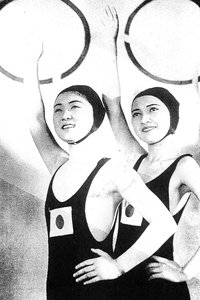
Shigeko and Midori, star swimmers at the renowned Kirishima Girls’ School, are training relentlessly with their sights set on the Los Angeles Olympics. But for the past week, Shigeko has been absent from practice. Her father has fallen ill, and to support her family’s struggling finances, she has secretly taken a job at a trading company. When Masao discovers this, he asks Midori to convince her to return, but soon the school learns of her secret. The students rally to raise funds, though the principal refuses their help, promising instead to handle the situation himself. Shigeko resumes training and travels to Tokyo for the qualifying meet. She touches the wall first in the 100-meter freestyle—only to receive news of her father’s passing. Overcome with grief, she collapses, cared for by Midori, whose own exhaustion leaves her finishing fourth. Despite these hardships, their prior accomplishments earn them a place on Japan’s Olympic team.
poster
?

The Tramp and His Daughter (1931)
Japanese silent film from 1931.
poster
?

Song of Youth (1930)
Shirō Kuroki, the adopted son of the Yamada family, shares a deep and mutual love with his foster sister, Kinuko Yamada. His commitment to political and social causes, however, provokes the anger of his foster father, who casts him out of the household. Forced into exile, Shirō faces hardship and struggle. The film was based on a serialized novel written by the poet Byakuren (real name Akiko Yanagiwara) and echoes the real-life scandal known as the Byakuren incident.
poster
?

Triumphant Song of the Mountain (1929)
Japanese silent film from 1929.
poster
?

Symphony of Youth (1928)
Japanese silent film from 1928.
poster
?

Young Master (1926)
Japanese silent film from 1926. (Obo-chan meaning "Young Master.") Written by Ayame Mizushima, the first female screenwriter in Japan.
poster
?

Scenes of Love (1929)
Japanese film from 1929.
poster
?

Haha o tataeru uta (1939)
A widow works as an insurance seller to raise her three children
poster
?
2.8
/12/

Moken no himitsu (1924)
When a nobleman is threatened by a family curse on his newly inherited estate, Sherlock Holmes is hired to investigate.
poster
?

Surging Waves (1939)
N/A
poster
?

Winter Camellia (1921)
Directed in 1921
poster
?

Sumida River (1942)
Inoue was something of a rarity in the sense, that he was a Shochiku house director who seems to have worked mostly in period films, often with big stars like Hasegawa or Bando. "Sumidagawa", named after the river that runs through Tokyo, is also a period film, but thematically a modern one. All the themes that you associate with the normal Shochiku women's films set in the present day are in this film, just in a different context: love, the planning of a marriage, career, family relations and societal melancholy. There is no action or swordplay.
poster
?

A Certain Woman (1942)
Pretty Oshige is deceived by her first love. After this, she lives a hard lifestyle, working at a number of jobs. Her only pleasure is her nephew, who eventually becomes a merchant marine. When Oshige meets her old love ten years later, she is able to forgive him and even thank him for the path her life has taken.
poster
?

Kare to Tokyo (1928)
N/A
poster
?

Umi mo yusha (1927)
N/A
poster
?

Arashi no naka no shojo (1932)
N/A
poster
?

Honoo no sora (1927)
Early feature film by Hiroshi Shimizu.
poster
?

The Living Corpse (1918)
A film adaptation of the play by Leo Tolstoy.
poster
?

Eikichi the Chauffeur (1924)
Directed by Minoru Murata.
poster
?

Daini no shuppatsu (1939)
N/A
poster
?

On the Verge of Spiritual Light (1922)
Directed by Kiyomatsu Hosoyama.
poster
?

Anguish of a Human Being (1923)
Directed by Kensaku Suzuki.
poster
?
4.2
/5/

Parent (1929)
A Japanese short film, the earliest extant film of the great director Hiroshi Shimizu.


mdblist.com © 2020 | Contact | Reddit | Discord | API | Privacy Policy